What’s the Difference Between Opto-MOSFET Relays and Solid-State Relays?
Solid-state relays (SSRs) are everywhere—from factory automation to precision test systems—because they switch electrically without moving contacts. Within this family you’ll often see a more specific term: opto-MOSFET relay. This article explains what each term means, how they work, where they differ, and when engineers typically choose one over the other.
Quick Definitions
How They Work (At A Glance)
-
Input/Isolation:
Both opto-MOSFET and triac SSRs typically use an input LED. When driven with forward current, the LED emits light across an isolation barrier. -
Output Stage:
- Opto-MOSFET: Light triggers a driver that turns on MOSFETs. Back-to-back MOSFETs allow current in either direction and block voltage both ways.
- Triac/Thyristor: Light triggers a device that latches on during an AC half-cycle and turns off when current falls below its holding current (for resistive AC loads this generally occurs at the next zero-cross).
Key Differences
| Aspect | Opto-MOSFET Relay | Triac/Thyristor SSR |
|---|---|---|
| Output device | MOSFET(s), often back-to-back | Triac or SCR pair |
| Works with | DC and AC within rated voltage (back-to-back MOSFETs for bidirectional blocking) | AC only (natural turn-off as current drops below holding current, typically at zero-cross) |
| Off-state leakage | Low (nA–µA range typical) | Higher (can be mA-level due to device and snubber paths) |
| “On” behavior | Low RON (I·R loss) | Conduction characterized by a voltage drop rather than RON |
| Off-state capacitance | Low (reduces feedthrough) | Less emphasized |
| Switching control | Fast, precise, not tied to waveform phase | Often zero-cross or random-turn-on variants for AC control |
| Typical strengths | Precision signals, measurement, DC paths | Cost-effective AC mains control |
When to Choose Each Relay?
- Choose an Opto-MOSFET Relay when you need low leakage, low off-capacitance, clean switching, and the ability to handle DC or AC within the device's rating. These traits matter in instrumentation, data acquisition, semiconductor test, battery systems, and signal multiplexing.
- Choose a Triac/Thyristor SSR when you're controlling AC mains for loads like heaters, lamps, and some motors — especially where zero-cross switching reduces EMI and stress.
Key Applications of Solid-State Relays
- Precision & Test: Opto-MOSFET relays excel in orce/sense paths, matrix switching, and high-impedance nodes where leakage and feedthrough must be tightly controlled.
- Battery & EV BMS: Optical isolation plus nA-to-µA leakage and predictable on-resistance make opto-MOSFET relays well-suited for sensing and protection paths.
- Facilities & Industrial AC Loads: Triac SSRs are a practical, economical choice for mains-powered heaters, lighting, and similar AC-only loads, often using zero-cross variants to limit EMI.
Toward Technologies' Solution
Highlighted series and key specs:
- 42 Series - up to 5A continuous load current
- 53 Series - up to 3,300V load voltage
- 74 Series - normally-closed configuration
- AS Series - 12mm creepage distance for robust isolation
- 46 Series - ~3 pF output capacitance for minimal feedthrough
Inside of Toward's Opto-MOSFET Relay

Summary
- “SSR” is the umbrella.
- Opto-MOSFET relays are MOSFET-output SSRs with optical isolation—strong on low leakage, low capacitance, fast and precise control, and DC compatibility (and AC within rating).
- Triac/Thyristor SSRs are AC-only specialists—robust and cost-effective for mains loads, often with zero-cross behavior.
- Mos Relays
-
SMD-6, 60V/ 5A, Opto-MOS Relay
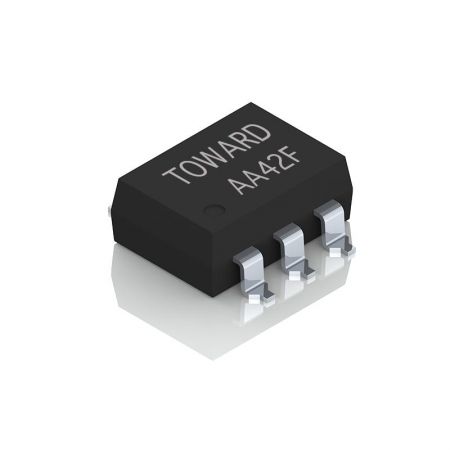
The 42 series is a SMD-6, load Voltage at 60V, load current up to 5 Amps, normally open IC Solid State Relay (1 Form A).
SMD6-5, 3300V/ 300mA, Opto-MOS Relay (SiC MOSFET)
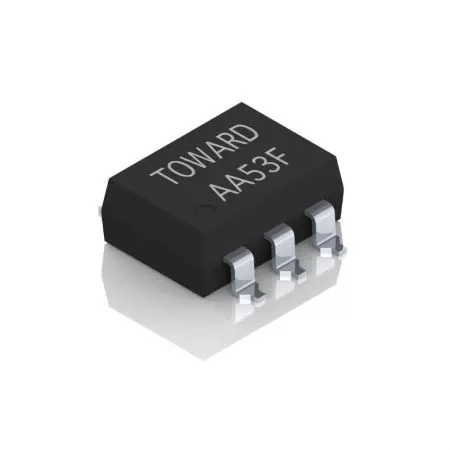
The 53 series is a SMD6-5, load Voltage up to 3,300V, load current at 0.3 Amps, normally open IC Solid State Relay (1 Form A).
SMD4, 400V/ 90mA, Opto-MOS Relay, SPST-NC (1 Form B)
The 74 series is a SMD-4 load voltage 400V, load current 90mA IC Solid State Relay is in a normally closed SPST contact arrangement (1 Form B).

SO-16, 3300V/ 350mA, Opto-MOS Relay (SiC MOSFET)
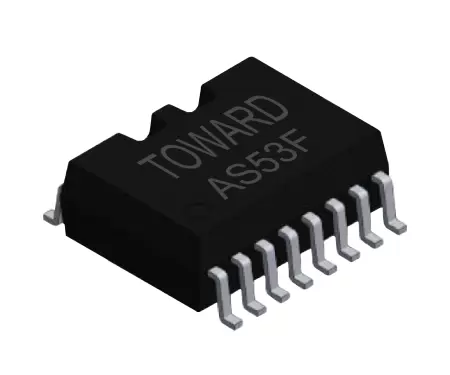
AS53F is a SMD6-5, load Voltage up to 3,300V, load current at 0.3 Amps, normally open IC Solid State Relay (1 Form A) with 12 mm creepage distance for robust isolation.
SMD-4, 80V/ 80mA, Opto-MOS Relay
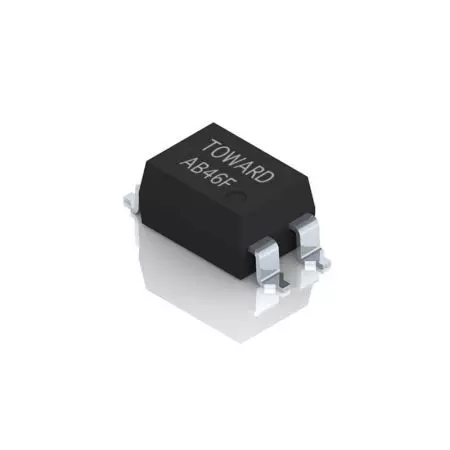
The 46 series provides 80V load voltage with up to 80mA of load current and ~3 pF output capacitance for minimal feedthrough.